Most people assume their website is fine. And most of the time, they're right - in the same way that most of the time, the smoke alarm battery is still working. The problem is that websites accumulate issues quietly. A security header that slipped during a server migration. A page that's started loading two seconds slower because of an image that never got compressed. An SEO tag that went missing in a redesign and nobody noticed.
You don't need to be a developer to check for these things. You just need the right tools - and with SiteVitals, several of them are free.
The quickest way: create a free account
If you create a free SiteVitals account, you get something more useful than a one-off report: you get continuous uptime monitoring, plus a full set of reports generated automatically across SEO, security, performance, and integrity - all in one place, all from the moment you sign up.
It takes about two minutes. No credit card. And the monitoring never stops, so you don't have to remember to check.
If you'd rather not hand over your email address just yet - that's fine, we understand - every report below is also available individually, with no account required. Just enter your URL and go.
Uptime: is your site actually online right now?
This sounds like a strange thing not to know. But "online" is relative. Your site might load in one location but not another. It might respond slowly enough that visitors give up before it finishes. It might be serving an error page while looking fine to you because your browser cached the last working version.
The only way to know for certain is to check from outside your own network, regularly, from multiple locations.
SiteVitals uptime monitoring checks your site every minute from UK and EU servers. If it goes down, you're the first to know - not a customer, not a client, not someone who screenshots your error page and posts it somewhere unhelpful.
Set up free uptime monitoring →
SEO Essentials: can Google actually find your pages?
A page can look completely normal to a visitor while being effectively invisible to a search engine. A missing title tag. A robots directive accidentally blocking the whole site. An H1 that got removed during a redesign. Structured data that stopped validating after a plugin update.
None of these feel dramatic. All of them affect whether your pages get found.
The free SEO Essentials scan checks your page's title and meta description, heading structure, indexing directives, HTTPS delivery, Open Graph tags, and more - and tells you what needs attention in plain English, not a wall of technical output.
Page Speed: how long are people actually waiting?
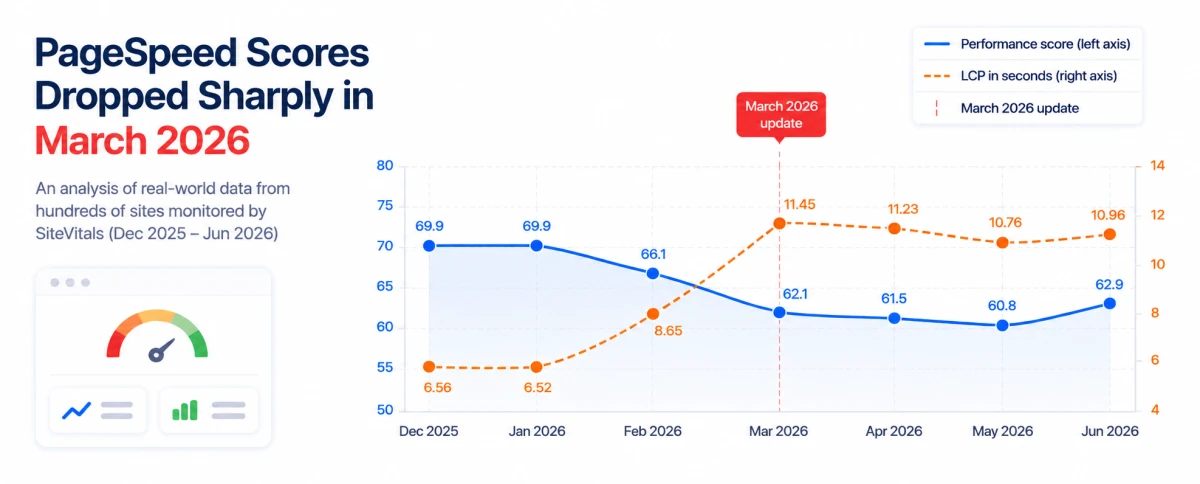
A one-second delay in page load time has a measurable effect on bounce rates. Two seconds is worse. Three seconds, and a significant proportion of visitors have already left - before they've seen a single word of your content.
The frustrating thing about slow pages is that they're often invisible from the inside. You visit your own site regularly, your browser has cached most of it, and your connection is probably faster than average. Your visitors don't have those advantages.
The free speed test runs your page through Google's PageSpeed Insights and translates the results into something actionable - not just a score, but a plain-English explanation of what's slowing you down and why it matters.
Security Scan: what are you quietly exposing?
Security issues on websites are rarely dramatic - until they are. Most of the time they're small gaps: a missing security header that makes clickjacking easier, a cookie without the right flags set, a version number exposed in your page source that tells anyone paying attention exactly which software you're running and which known vulnerabilities apply.
These things don't announce themselves. They sit there, quietly, until someone pays attention to them.
The free security scan checks your page's HTTP headers, cookie configuration, mixed content, and several other signals that indicate how your page behaves in a browser - and flags anything that's worth looking at, with an explanation of what it means.
Site Integrity: what's expiring while you're not looking?
The most avoidable website problems are administrative ones. An SSL certificate that wasn't renewed because the auto-renewal failed and nobody noticed. A domain that lapsed because the renewal email went to an address nobody checks any more. A font or image that stopped loading because a CDN changed its URLs.
None of these require a developer to fix. They all require someone to notice in time.
The free integrity scan checks your SSL certificate health and expiry date, domain status, broken assets, DNS configuration, and mixed content - the quiet, administrative layer of your site that has nothing to do with code and everything to do with whether things continue to work.
One scan is a snapshot. Monitoring is a habit.
Each of these free scans tells you what's true about your site right now. That's genuinely useful - but a website is not a static thing. It gets updated. Plugins change. Content gets edited. Certificates approach expiry. Scripts get added.
What happened between the last time you checked and today is often where the interesting problems are.
If you'd like SiteVitals to watch your site continuously - catching issues as they appear rather than whenever you remember to look - a free account gives you uptime monitoring forever, with the option to add SEO, security, performance, and change monitoring from £2.50 a month.
Start free, no credit card needed →
SiteVitals is built and run in the UK by Lisa and Tom - two people with 25 years of web development experience who got tired of finding out about site problems from clients. We built the tool we always wished existed.

By Lisa Freeman · Co-Founder
Industry veteran with 25+ years experience in web development and client experience.
Share this post
Stay in the loop
Get new posts delivered to your inbox. No spam, unsubscribe any time.