When we built the original SEO dashboard, the brief was straightforward: flag the technical issues that hurt search rankings. Missing title tags. Broken links. Noindex directives left in by mistake. But the landscape has shifted over the past few months and the list of things site owners and administrators need to consider to appear in AI-assisted search keeps growing and getting more complicated. ChatGPT, Perplexity, Google AI Overviews, and the AI agents are beginning to browse the web on users' behalf. These systems don't just read your title tag. They parse your schema, verify your entity identity, check whether your content is structured for extraction, and decide whether to trust you as a source.
The old dashboard was fine, but the more checks we added, the more confusing it was becoming.
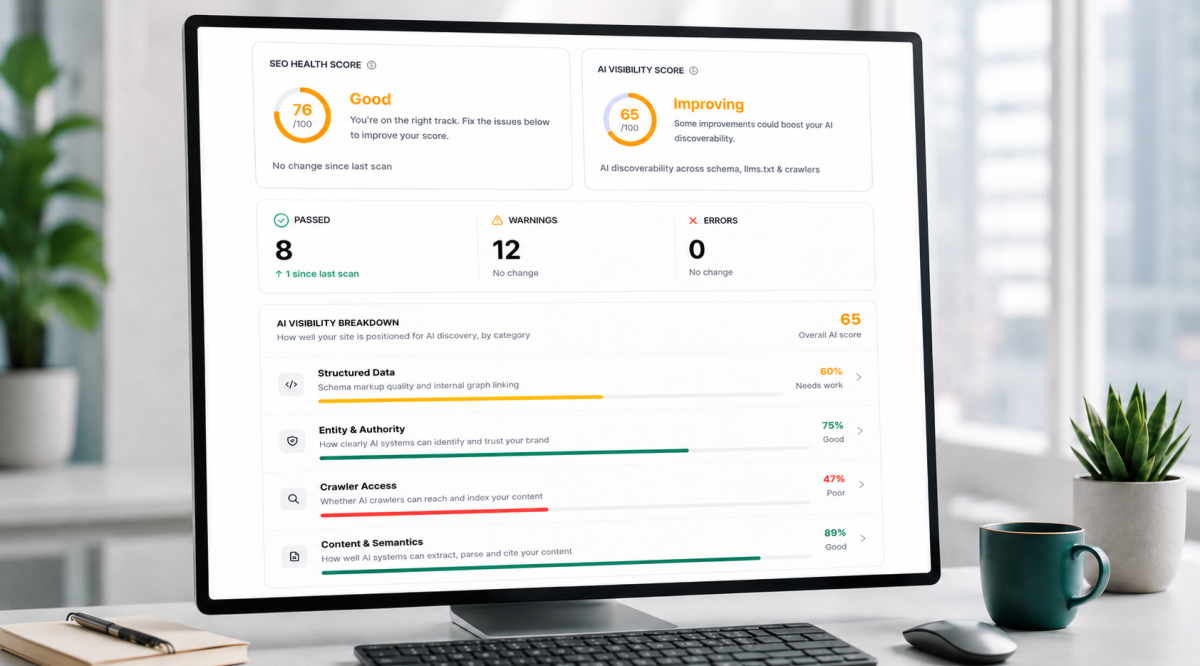
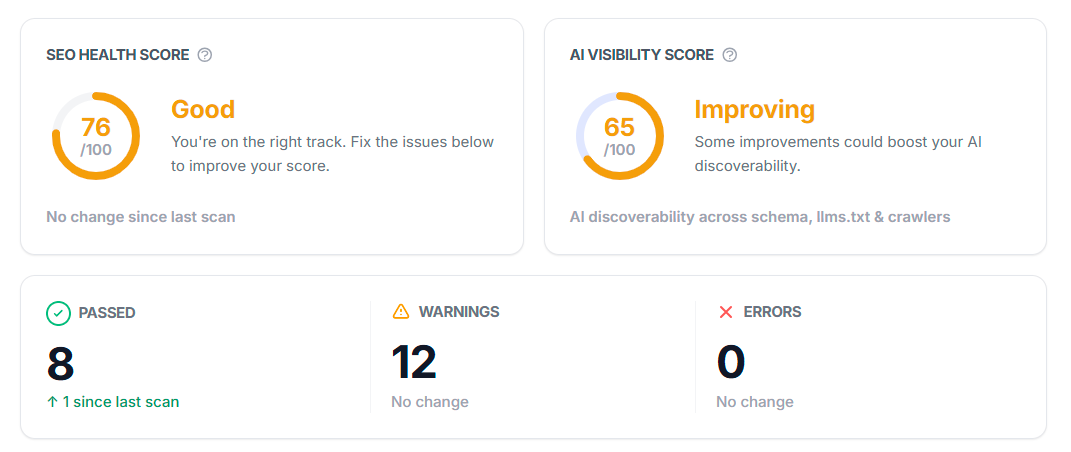
The new dashboard opens with three things: your SEO Health score, your AI Visibility score, and a count of errors, warnings, and passing checks — with a delta against the previous scan so you can see immediately whether things are improving or regressing.
Beneath the scores, Top Priorities replaces the old flat table as the first thing you see. Every issue on the site is ranked by impact, with a plain-English title and a "How to fix" button that opens a detail panel on the right — no page navigation, no losing your place.
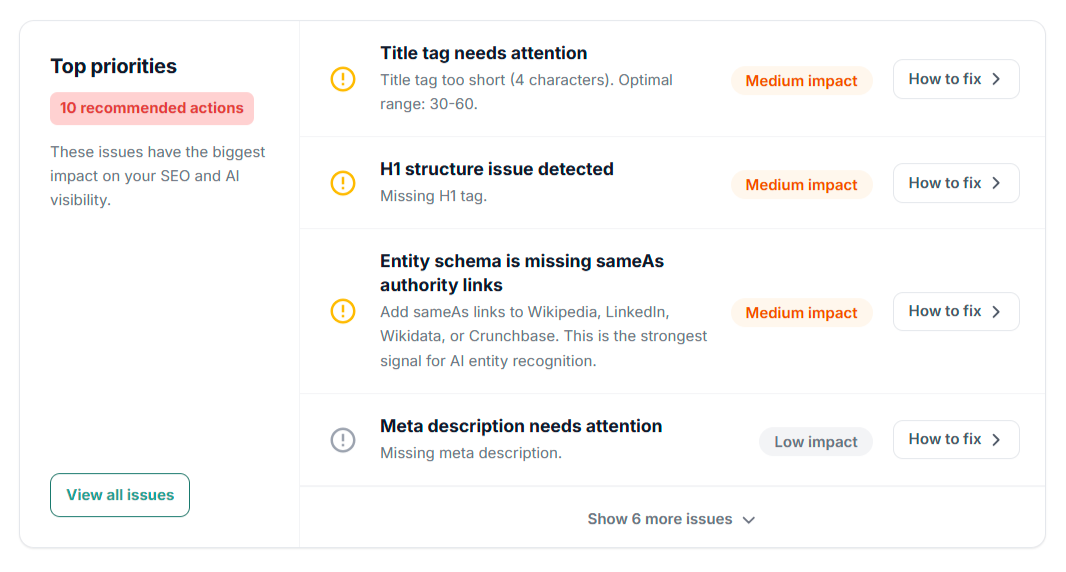
One thing worth knowing: the priorities list can show more items than your error and warning count. Some checks, like Interactive Semantics or Schema Validation, are composite checks that can contain multiple distinct issues. Each one surfaces as a separate action item because each one requires a separate fix. The error and warning count reflects the number of checks with issues; the priorities list reflects the number of things to actually do.
Checks grouped by what they actually mean
The full check breakdown is still there — all twenty checks, fully expandable — but they're now grouped into six categories that reflect how search engines and AI systems actually think about your site:
| Group | Checks included |
|---|---|
| Basics | Title tag, meta description, H1, image alt text, canonical, Open Graph |
| Indexing & Crawling | HTTPS redirect, indexing status, mixed content, broken links, AI crawler access, llms.txt |
| Schema & Structured Data | Schema validation, graph linking, title/schema consistency |
| E-E-A-T & Entity | Entity disambiguation, author/publisher chain |
| Content & AI Readiness | Content extractability, heading structure, paragraph density |
| Page Semantics | Semantic HTML landmarks, interactive element labelling |
Each group shows its own pass/fail/warning summary, and a coloured border makes problem areas visible before you open anything. Groups with no issues stay compact. Groups with failures surface their problems immediately.
New: AI Visibility Breakdown
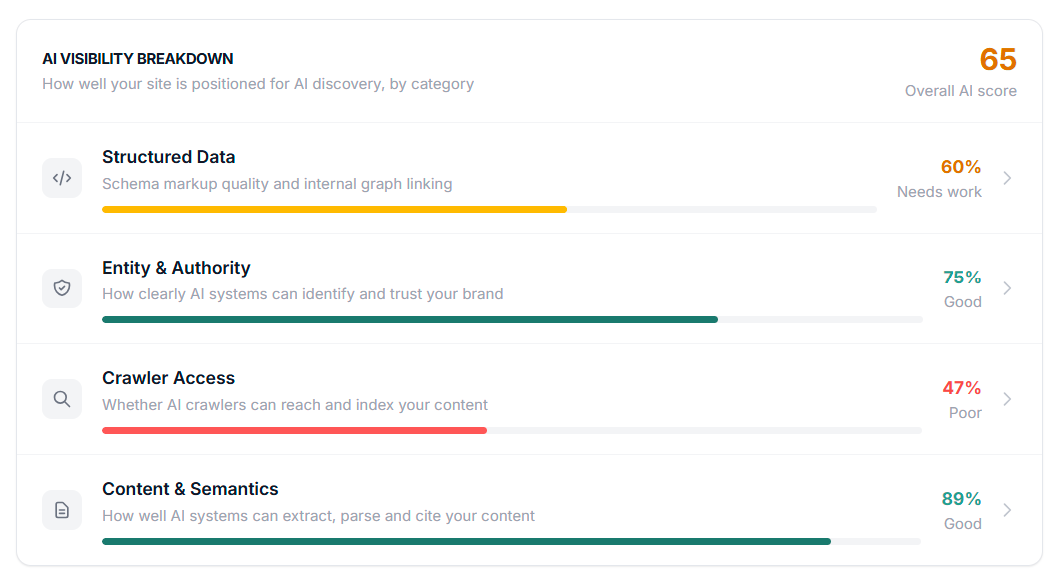
The AI Visibility score has becoming increasingly important to understand. But a single number doesn't tell you where to focus. The new AI Visibility Breakdown shows how that score is composed across four categories, each with its own score and progress bar.
Structured Data
Schema validation quality, @id graph linking, title/schema consistency
Entity & Authority
sameAs links, knowsAbout declarations, author/publisher E-E-A-T chain
Crawler Access
AI crawler permissions, llms.txt presence and quality, social media tags
Content & Semantics
Content extractability, semantic HTML landmarks, interactive element labelling
Clicking any category opens a panel showing all the checks that contribute to that score — each expandable for full detail. A site that scores well on Structured Data but poorly on Entity & Authority knows exactly where to focus without having to interpret a single aggregate number.
Your AI Visibility score may have changed
Your AI Visibility score will likely look different after this update. The previous AI score was calculated from five checks. The new one draws from eleven, including checks that didn't exist yet when the original score was built:
- + Entity disambiguation (sameAs authority links, knowsAbout topical expertise)
- + Schema graph linking (@id cross-references)
- + Content extractability (heading structure, paragraph density, Q&A patterns)
- + Semantic HTML (landmark structure, time elements, figure captions)
- + Interactive semantics (form labelling, ARIA states, agent-readable navigation)
- + Author/publisher E-E-A-T chain
See the new dashboard for yourself
Run a scan on any site and explore the AI Visibility Breakdown.
Questions about the new scoring, or want to talk through how it applies to a specific client site? Get in touch — we're a small team and we read everything.

By Tom Freeman · Co-Founder & Lead Developer
Full-stack developer specialising in high-performance web applications and automated monitoring.
Share this post
Stay in the loop
Get new posts delivered to your inbox. No spam, unsubscribe any time.