SEO Health Monitoring

Your page can look perfect to visitors and be invisible to Google. invisible to Google.

Missing title tags, a forgotten noindex directive, and broken links erosion rankings. SiteVitals monitors the technical signals that determine if your pages actually get found.

Run a Free SEO Check
See Continuous Monitoring →

No signup required · Under a minute

🔎

Search engine interpretation

How clearly search engines can read your page intent from titles, descriptions, and heading structure.

🤖

Crawlability & indexing

Whether robots directives, noindex tags, and canonical settings are letting the right pages through — or accidentally blocking them.

🔗

Link & asset health

Broken internal links, missing image attributes, and failed assets that weaken crawl efficiency and trust signals.

🎉

Structured & social data

Schema markup and Open Graph tags that influence rich results, search appearance, and social sharing.

📈

Continuous drift detection

Compares every scan against your baseline so regressions introduced by updates or deployments get caught immediately.

Generate your instant SEO report

No account needed. Results in seconds.

Free SEO Snapshot

See how search engines currently interpret your page.

Search engines need a clear, well-structured page to understand what your content is about and when it should appear in results. Small technical issues — a missing title tag, a page accidentally blocked by robots.txt, a broken link in the footer — can quietly stop content from being indexed or shown properly, without producing any visible errors for a real user.

Our free SEO snapshot takes a quick, read-only look at how a search engine currently sees a page, highlighting the structural and crawlability issues that are easiest to miss but slowest to recover from. No signup required. Nothing installed or changed on your site. Just enter a URL and get a clear report.

It is not a full content or keyword audit — it focuses on the technical and structural signals that determine whether your pages can be properly crawled, indexed, and displayed. If issues come back after you fix them, that is where continuous monitoring picks up.

🔎

Search engine interpretation

Reviews your meta titles, descriptions, and heading hierarchy to see how clearly search engines can read your page and understand what it is about.

🤖

Crawlability snapshot

Identifies blocked pages, robots directives, canonical issues, and indexing signals that may be preventing content from being crawled or appearing in search results.

🔗

Link & asset visibility

Detects broken internal links, missing image alt attributes, and asset issues that reduce crawl efficiency and weaken trust signals across your site.

📝

What to do with the results

Issues can be fixed manually or with developer support. If you want to make sure they do not creep back in after future updates, continuous monitoring watches for that automatically.

Why a Snapshot Is Only the Start

SEO issues do not just appear once
and stay fixed.

Technical SEO configurations change every time a template is updated, a plugin is modified, a new page is deployed, or content is restructured. Issues that are not present today can be introduced silently tomorrow — and they rarely produce any error messages when they do.

A robots.txt that was correctly configured gets overwritten during a site migration. A noindex tag added for a staging environment makes it into production. A canonical tag on a key landing page starts pointing to the wrong URL after a CMS update. None of these are visible to users. All of them can quietly kill a page’s search visibility.

“Technical SEO issues remain one of the top reasons websites lose organic traffic — broken pages, indexing errors and configuration drift are among the most common culprits.”

Search Engine Journal, 2025

Continuous monitoring means SiteVitals checks your pages regularly, compares results against your established baseline, and alerts you the moment a meaningful regression appears — so you find out before your rankings do.

CRITICAL DETECTED
🚫

The noindex tag that made it to production

A developer adds a noindex meta tag during staging to keep pages out of search while they are being built. It gets missed in the final review and goes live. The page disappears from Google within days. Nobody notices for three weeks.

REGRESSION DETECTED
🔄

The canonical that started pointing the wrong way

A CMS update or template change silently alters the canonical tag on a key page, telling search engines to treat a different URL as the authoritative version. Rankings consolidate to the wrong page, or disappear entirely.

WARNING DETECTED
🔗

The broken link introduced by a content update

Someone renames a page or deletes an old post without updating internal links. Broken links spread quietly through the site, reducing crawl efficiency and signalling poor maintenance to search engines.

REDUCED DETECTED
📋

The structured data that stopped validating

A template change breaks the Schema.org markup that was generating rich results in Google. The rich snippets disappear from search — often noticed by the client before the team, because they are watching their own click-through rate.

The Bigger Picture

Technical SEO is having
a real resurgence.

For years, SEO conversations were dominated by content and backlinks. Technical SEO was important but often treated as a one-time setup job. That is changing fast.

AI-powered search — Google’s AI Overviews, LLM-based answer engines, agentic AI tools that browse and recommend on behalf of users — all depend on being able to clearly read, parse, and understand your site. If your technical foundation is weak, AI search tools will either misrepresent your content or skip it entirely.

The businesses that will benefit most from AI search are the ones whose sites are technically clean, well-structured, and consistently maintained. SiteVitals helps make sure yours stays that way.

🤖

AI crawlers need clean structure

LLMs and AI search tools rely on semantic HTML, correct metadata, and valid schema to understand what a page is about and when to recommend it.

📈

Rankings are no longer the only metric

Appearing in AI Overviews, featured snippets, and agentic recommendations depends on being technically trustworthy — not just well-ranked.

Structured data is more important than ever

Valid Schema.org markup helps both traditional search engines and AI tools understand your content type, context, and authority.

🔗

Crawlability determines discoverability

If a page cannot be reliably crawled and indexed, it does not matter how good the content is. This is the foundation everything else builds on.

What Continuous Monitoring Covers

Six areas of technical SEO
checked every time we scan your site.

Here is what SiteVitals monitors continuously — with the plain-English explanation up top, and the technical detail underneath for whoever needs it.

🔎

Page Titles & Meta Descriptions

Title tags and meta descriptions are the first thing search engines use to understand what a page is about — and the first thing users see in search results. Missing, duplicated, or badly configured ones can harm both rankings and click-through rates, often without anything appearing wrong on the page itself.

The technical bit
  • Title tag present and within optimal length (30–60 characters)
  • Meta description present, unique across monitored pages, and within optimal length (70–160 characters)
📃

Heading Structure & H1 Hierarchy

Headings do two jobs at once: they help users navigate your content, and they tell search engines what a page is about. A page with no H1, multiple H1s, or headings that skip levels signals structural confusion to both. It is the kind of thing that is easy to introduce accidentally during a redesign and rarely noticed until it is already affecting performance.

The technical bit
  • Exactly one H1 per page — missing or multiple H1s flagged
🔗

Link & Content Health

Broken links are more than a user experience problem — they signal to search engines that a site is not being actively maintained, which can reduce crawl efficiency and trust across the whole domain. Mixed content (HTTP resources on HTTPS pages) quietly undermines the security signals search engines use to assess site quality.

The technical bit
  • Broken internal links (4xx and 5xx responses)
  • Broken external links with configurable severity thresholds
  • HTTP resources (scripts, images, styles) loaded on HTTPS pages
🔒

HTTPS & Secure Delivery

Serving pages securely is table stakes for SEO — Google has used HTTPS as a ranking signal since 2014. But misconfigurations around redirects and certificate validity still catch sites out, particularly after migrations, hosting changes, or SSL renewals that did not go smoothly.

The technical bit
  • Valid SSL/TLS certificate covering the monitored URL
  • Mixed content detection (HTTP assets on HTTPS pages)
🤖

Indexing, Robots & Canonicals

This is where some of the most damaging — and hardest to spot — SEO problems live. A single misconfigured directive can prevent an entire section of a site from appearing in search results. Robots files, noindex tags, and canonical tags all interact in ways that are easy to get wrong and difficult to notice once they are wrong.

The technical bit
  • robots.txt crawl permissions for monitored pages
  • Meta robots noindex / nofollow directives — accidental and intentional
  • Canonical tag presence
🎉

Structured Data & Social Tags

Structured data (Schema.org markup) tells search engines the specific type of content on a page — article, product, event, FAQ — and is what generates rich results in search. Open Graph and Twitter card tags control how your pages appear when shared on social platforms. Both are easy to break silently during template updates.

The technical bit
  • JSON-LD and Microdata Schema.org presence
  • Open Graph essential tags: og:title, og:description, og:image, og:url
  • Twitter Card tags: twitter:card, twitter:title, twitter:image
How It Works

Set up once. SiteVitals keeps
your SEO foundation solid.

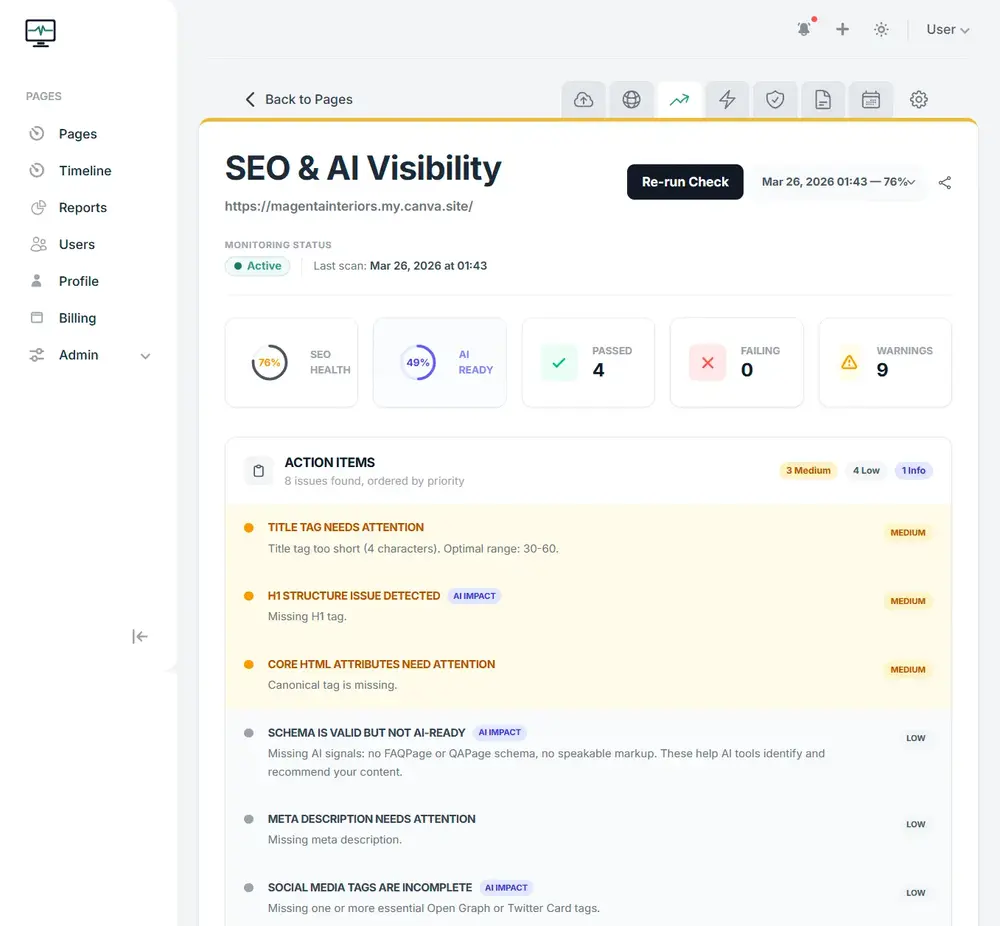
No plugins, no code changes. SiteVitals monitors your live pages externally and alerts you when something drifts.

1

Audit & Benchmark

When you add a page, SiteVitals runs a thorough SEO audit and establishes a clear baseline across titles, meta tags, headings, links, indexing rules, and structured data. Every metric is scored and explained in plain language.

  • Baseline SEO scores established for all monitored pages
  • Broken links, missing tags, and structural gaps identified
  • Issues explained clearly — no jargon without context
2

Continuous Monitoring & Alerts

SiteVitals continually scans your pages and compares results against the baseline. When a meaningful regression appears — a broken link, a lost title tag, a noindex that should not be there — you are alerted immediately.

  • Configurable alerts: email, in-app, webhooks
  • Alerts trigger on meaningful regressions, not minor fluctuations
  • Issues prioritised by potential ranking and traffic impact
3

Zero Disruption

SiteVitals monitors your live site from the outside. Nothing is installed on your server, nothing is added to your pages, and there is no impact on performance or visitors.

  • No plugins, scripts, or server-side changes required
  • Works on live production sites from day one
  • Handles redirects and cookies correctly

See SiteVitals in action

No screenshots here. This is a live, interactive report showing exactly how we monitor your seo essentials.

sitevitals.co.uk/report/demo

Avoid embarrassing silent failures

SEO issues often sneak in quietly. Sometimes directives are accidentally put in place that prevent pages being discovered by search engines. Broken links, mixed content, or missing structured data can creep in during updates or content additions, gradually harming your visibility and user experience.

These problems aren’t always obvious — your site may look perfect to a visitor, but search engines could be missing or penalizing key pages. By regularly checking these core SEO elements, you catch errors early, maintain optimal search performance, and ensure that every page has the best chance to be found and properly displayed in search results.

Consistent SEO monitoring is not just a technical exercise — it’s essential for keeping your website healthy, discoverable, and performing at its best in the real world.

Not ready to commit yet? Run a free SEO essentials report to see whether any issues need attention right now.

Avoid Embarrassing Silent Failures

Professional monitoring shouldn't have enterprise pricing.

Get started with our free tools today. When you're ready for continuous seo monitoring, our plans are simple, transparent, and built for sites of all sizes.

Plans start from
£2.50/mo
View All Plans & Features
Questions

Things people often ask us.

If something is not covered here, we are genuinely happy to answer it. We are a small team and we actually respond.

Is the free scan a full SEO audit?

No — and it is worth being clear about what it is and is not. The free snapshot is a technical and structural SEO check: it looks at metadata, heading structure, crawlability, indexing directives, and link health. It does not evaluate keyword strategy, content quality, backlinks, or competitive positioning. Think of it as checking whether the foundations are in good shape — not whether the whole SEO strategy is working.

Does this analyse keywords or content quality?

No. SiteVitals focuses on technical SEO signals — the structural and configuration issues that determine whether search engines can properly find, crawl, and understand your pages. Keyword research and content strategy are separate disciplines that sit on top of this foundation. If the technical foundation is broken, content quality becomes largely irrelevant to rankings.

Can a page look fine to users but have SEO problems?

Yes — and this is one of the most important things to understand about technical SEO. A page can render perfectly in a browser while being invisible to search engines. A noindex meta tag, a blocking robots.txt entry, a canonical pointing to the wrong URL, or broken structured data all affect search visibility without producing any visible error for a real user. These are the issues SiteVitals is specifically built to catch.

Why is continuous SEO monitoring better than running audits occasionally?

Because SEO configurations change constantly. Every content update, plugin change, template modification, or deployment is an opportunity to introduce a regression — a new noindex that was not there before, a canonical that changed, a title tag that got overwritten. Occasional audits catch issues at a point in time. Continuous monitoring catches them when they happen, so you find out before your rankings do.

Will I be alerted if SEO issues appear after a site update?

Yes. SiteVitals continuously compares new scans against your established baseline and sends an alert when a meaningful regression appears — a broken link, a lost title tag, a new noindex directive, a canonical mismatch. Alerts are configurable by channel (email, in-app, webhook) and are only triggered when something actually changes, not on every minor fluctuation.

How does technical SEO relate to AI search?

More directly than most people currently realise. AI search tools — Google’s AI Overviews, LLM-based answer engines, agentic AI tools that browse on behalf of users — all rely on being able to clearly read, parse, and understand your pages. Valid structured data, correct canonical signals, clean heading hierarchy, and unblocked crawlability all help AI tools understand what your content is about and when to recommend it. Sites with weak technical foundations are increasingly likely to be misrepresented or passed over entirely in AI-mediated search.

Do I need to install anything to use SEO monitoring?

Nothing at all. SiteVitals monitors your pages externally, without installing plugins, agents, or making any changes to your site. There is no impact on performance and no risk of introducing new issues. You just add the pages you want to monitor and SiteVitals does the rest.

Who should use SEO health monitoring?

Anyone who cares about their site being found in search — which in practice means site owners, marketers, developers, and agencies managing client sites. It is particularly valuable for teams where the people responsible for content are different from the people responsible for technical changes, because it creates a safety net that catches regressions regardless of where they come from.

Start with the free check. Know where you stand right now.

No account needed. No changes made to your site. Just a clear picture of what search engines are currently seeing - and whether your pages are getting the visibility they deserve.