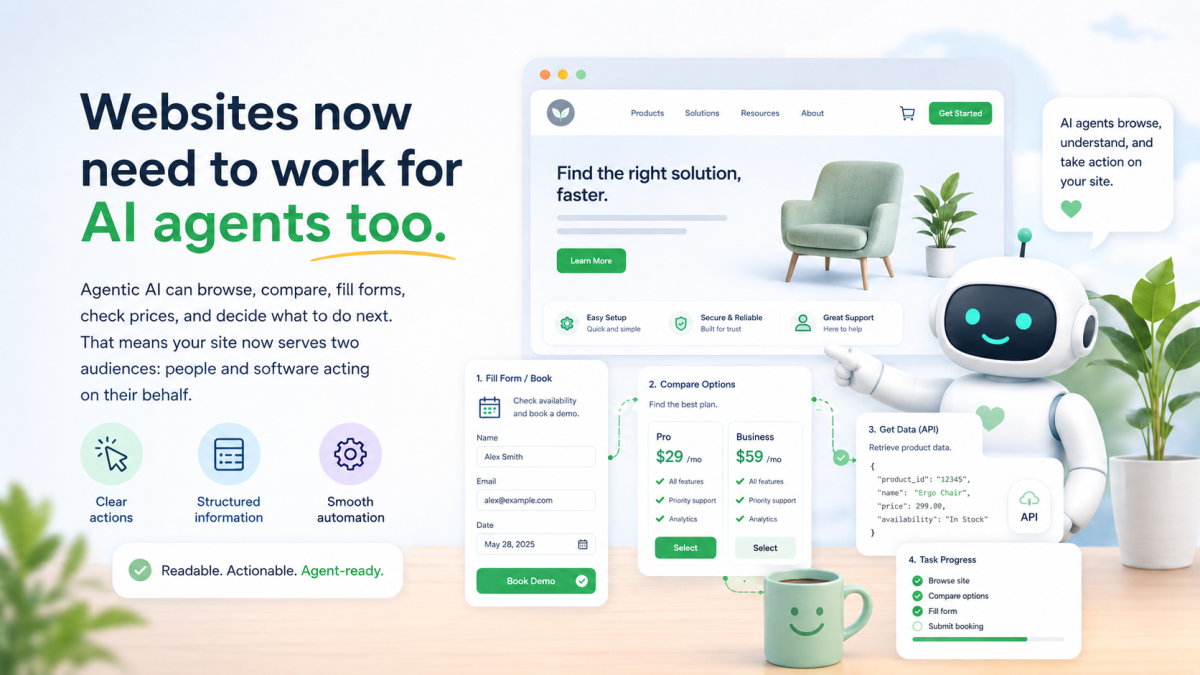
In short: "Agentic website use" means AI programs — not just people — visiting your website to complete tasks on someone's behalf, like checking your opening hours, filling in a form, or comparing your prices. It's happening now, and a website that's easy for people to use isn't automatically easy for an AI agent to use.
You've probably heard people say that AI is starting to "browse the web" on our behalf. This guide explains what that actually means, why it matters for your website, and a few simple things you can do about it — no technical background needed.
What is an AI agent?
An AI agent is a computer program — often built on the same kind of AI behind tools like ChatGPT or Claude — that can visit websites and take actions, not just answer questions. Instead of a person clicking around your site, an agent visits it on someone's behalf: checking your opening hours, filling in a contact form, comparing your prices to a competitor's, or booking an appointment.
Think of it like sending a very fast, very literal-minded assistant to run an errand for you. It can read a page and click a button, but it doesn't have your intuition. If your website is confusing, cluttered, or relies on things a human would just "figure out," the agent is far more likely to get stuck.
Why does this matter for my website?
This isn't a future trend — it's happening now. AI browsers and AI-powered assistants are already visiting real websites to complete real tasks, and that traffic is quietly growing in website logs across the internet.
That means your website now has two audiences: people, and the AI tools acting for them. A website that only works well for one of those audiences is going to miss opportunities — whether that's a customer who asks an AI assistant to find and book a local service, or an AI research tool trying to summarise what your business actually offers.
The good news: almost everything that makes a website good for AI agents also makes it better for actual people. Clear content, working links, and a site that doesn't rely on confusing pop-ups or hidden menus helps everyone.
What can I actually do about it?
You don't need to be technical to make real progress. Here's where to start:
- 1 Write in plain, clear language. Say what your business does, where you are, and what you offer — in normal sentences, not just images or slogans. Agents (and search engines) read text, not pictures.
- 2 Keep your navigation simple and consistent. Clear menus, sensible page names, and working links help an agent find its way around just as much as they help a visitor.
- 3 Fix broken links and missing pages. A dead end that a human would shrug off and work around can stop an agent completely.
- 4 Make forms and buttons properly labelled. If your web developer can add clear labels to buttons and form fields (not just icons or colour), both AI tools and people using screen readers will thank you.
- 5 Decide how you feel about AI crawling your content, and let your web developer know. There are simple, standard ways to tell AI tools "yes, you can read this" or "no, please don't" — you get to choose.
Do I need to be technical to fix this?
No. This isn't something you need to fix yourself. The main thing is knowing it's a real, current consideration, and asking whoever manages your website whether it's something they're thinking about. If you use a monitoring tool like SiteVitals, this is exactly the kind of thing we check for automatically, in plain language, so you don't have to become an expert in it.
The web is changing to make room for a new kind of visitor. You don't need to master the technical detail — you just need to know it's happening, and make sure someone's paying attention to it on your behalf.
Common questions
Is "agentic website use" the same as SEO?
No, though they overlap. SEO is about being found and ranked by search engines. Agentic readiness is about whether an AI program can actually navigate your site and complete a task once it arrives. A site can rank well in search and still trip up an AI agent trying to fill in a form.
Do I need to rebuild my website for AI agents?
Almost never. Most of what helps is the same good practice that's always made a website better: clear writing, working links, sensible navigation, and properly labelled buttons and forms. Rebuilding is rarely necessary.
Can I stop AI agents from visiting my website?
Yes. There are standard, widely-respected ways to tell AI crawlers and agents what they can and can't do with your content, similar to how websites have long told search engines which pages to index. A web developer can set this up in minutes once you've decided your preference.
Where can I learn more about the technical side?
Our companion article, Is Your Website Ready for AI Agents?, goes into the technical standards involved, and Cloudflare's Agent Readiness research is a good independent overview of how widely these standards are adopted today.
Not sure how your website measures up?
Run a free SEO & AI Readiness scan and get a plain-English report on how your site performs today — no technical knowledge required.
Run your free scan
By Tom Freeman · Co-Founder & Lead Developer
Full-stack developer specialising in high-performance web applications and automated monitoring.
Share this post
Stay in the loop
Get new posts delivered to your inbox. No spam, unsubscribe any time.