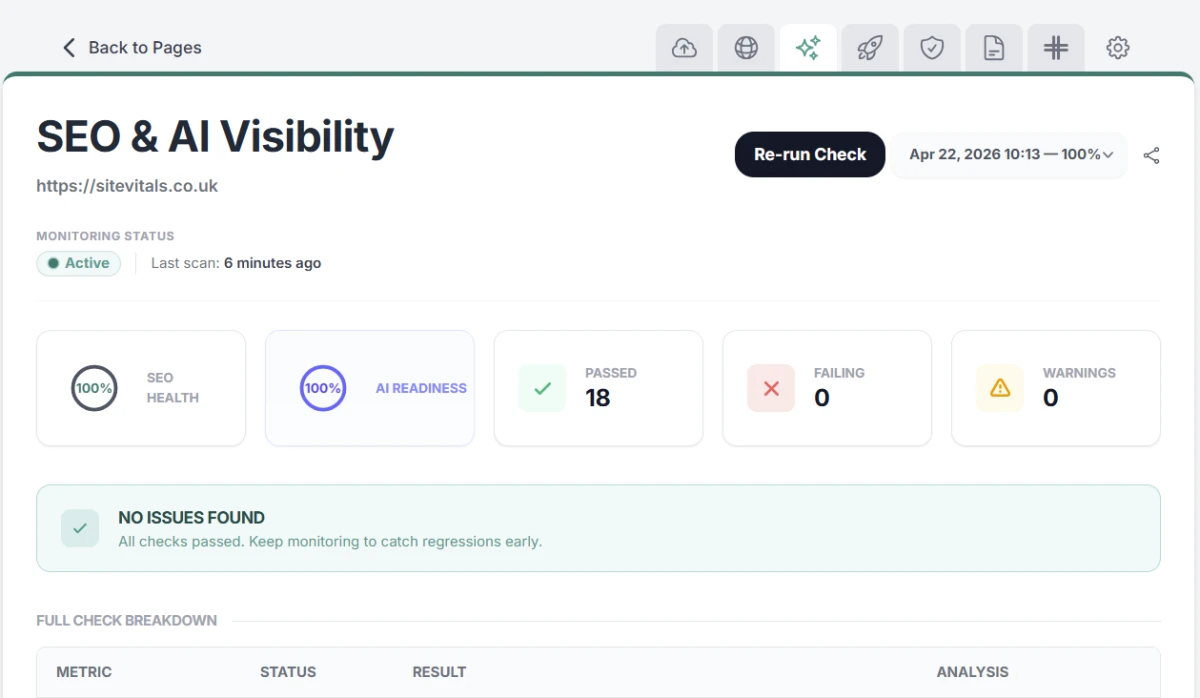
What this analysis measures
- Q&A Headings — question-phrased headings help AI match your content to real queries.
- AI-Ready Paragraphs — 50–150 words is the sweet spot. Low scores on marketing pages are normal.
- Structure Score — lists and tables signal fact-density. Above 2.0 is excellent.
- Long Paragraphs — aim for zero. Anything over 250 words gets skipped by AI citation systems.
This post is talking about the 'Content Extractability' section of our SEO report. Log in and look at your SEO dashboard to see your current scores, or if you're not yet set up, you can run a free report here.
There is a particular kind of frustration that comes from a tool showing you a number with no explanation of where it came from. A score of 13% sits there on your screen, presumably bad, and you have no idea whether it reflects a fundamental problem with your content or just the way you write landing page copy.
The AI content extractability analysis in SiteVitals is new, and the metrics it surfaces are not ones most people have encountered before. So rather than leaving you to reverse-engineer what they mean, this post explains each one directly: what we are measuring, why it matters for AI systems specifically, and how to interpret what you are seeing.
Why "AI extractability" is a thing worth measuring at all
Search is changing. Tools like ChatGPT, Perplexity, Google's AI Overviews, and a growing number of AI assistants do not just link to your content, they read it, extract specific claims from it, and synthesise those claims into answers. When someone asks one of these tools a question and your page contains the answer, the question is whether the AI can actually find and use it.
This is sometimes called Retrieval-Augmented Generation, or RAG. The short version: AI systems break your content into chunks, evaluate those chunks for relevance and coherence, and decide which ones are worth citing. Content that is well-structured, clearly written, and appropriately sized for these chunks gets cited. Content that is dense, vague, or poorly signposted gets skipped.
None of this replaces traditional SEO. It adds a layer on top of it. You still need your pages to rank. But increasingly, ranking is not enough, the content also needs to be in a form that AI systems can actually use.
That is what this analysis measures.
Q&A Headings: the ratio that looks scarier than it is
The first metric is your Q&A heading ratio. This is the proportion of your H2, H3, and H4 headings that are phrased as questions rather than statements.
Why does this matter? When an AI system is trying to match a user's question to a piece of content, it has a much easier job if your headings are already questions. "What does SiteVitals monitor?" is a direct semantic match for someone asking that exact thing. "Features" is not. The heading acts as a navigational signal, both for the AI and for the human reader.
A Q&A ratio of 0.25 means roughly one in four of your headings is a question. Whether that is good or bad depends almost entirely on the type of page you are looking at. A FAQ page should be close to 1.0. A product features page might legitimately sit at 0.0 and still perform well, because the structural signals elsewhere (lists, tables, clear subsections) do the same job.
The metric is most useful in combination with the linkable headings count - headings that carry an ID attribute, which means an AI system or a human linking to your content can point to a specific section rather than just the page as a whole. If your headings are not questions but they are all anchored and well-labelled, you are probably fine.
Where you should pay attention is when both are low. No question headings and no anchor IDs typically means your content structure is flat, and AI systems have to work harder to figure out what each section is actually about.
AI-Ready Paragraphs: the Goldilocks problem
This is the metric most likely to raise eyebrows, because 13% sounds terrible until you understand what is being measured.
AI systems that extract and cite content work best with chunks that are substantial enough to contain a complete thought but small enough to fit within a usable context window. Through a combination of research and practical observation, the range that tends to work well is roughly 50 to 150 words per paragraph. We call this the Goldilocks zone, not too thin to be meaningless, not so long that the relevant detail gets buried.
A score of 13% means 13% of your paragraphs fall within that range. The rest are either shorter or longer.
Here is the thing though: a low Goldilocks ratio is not automatically a problem. If you are running a SaaS marketing site with punchy, persuasive copy — one-sentence hooks, short benefit statements, quick CTAs — your ratio will be low because that is just how that kind of content is written. It converts well. It reads well. It is just not optimised for AI citation, because there is not enough depth in any single chunk for an AI to extract a meaningful, citable claim from it.
Whether that matters depends on what you want the page to do. A homepage optimised for conversion is doing its job. A product explainer, a comparison page, or a how-to article that you want to appear in AI-generated answers needs more substance per paragraph.
The diagnostic section in the analysis will show you which paragraphs are flagged as "thin" (under 30 words) and which are flagged as too long (over 250 words), so you can see exactly what is pulling the ratio down rather than just getting a number.
Structure Score: what the ratio actually means
The structure density score measures how fact-dense your content is relative to its length. The calculation weights lists and tables against your total paragraph count, with tables weighted more heavily because they compress a high volume of structured facts into a small space.
As a rough guide to interpreting the number:
- 0 to 0.2 — text-heavy content. Mostly prose, few structured elements. Harder for AI systems to extract discrete facts from.
- 0.5 to 1.0 — well-balanced. A reasonable mix of narrative and structure.
- 2.0 and above — highly structured. Your content is primarily organised into lists and tables, which AI systems treat as a reliable source of facts.
A score of 3 is genuinely good. It does not mean your content reads like a spreadsheet, it means that relative to the amount of prose, you have a meaningful amount of structured data. AI systems encountering a page like this will tend to prioritise the lists and tables for factual extraction while using the surrounding prose for context.
The one caveat worth knowing: the score becomes less meaningful on very short pages. If you have two paragraphs and one table, you will get a high density score, but it does not tell you much. The metric is most reliable on pages with at least five or six paragraphs of substantive content.
Long Paragraphs: the one you actually want to be zero
This is the simplest metric to interpret. It counts paragraphs over 250 words.
Long paragraphs are a problem for AI extraction because semantic meaning gets diluted. When a paragraph runs to 300 or 400 words, it typically covers multiple points, qualifies itself several times over, and contains a mixture of important claims and supporting detail. An AI system trying to identify a citable fact from that paragraph has to do a lot of work to isolate it — and often will not bother, defaulting instead to shorter, cleaner chunks elsewhere on the page or from a competitor's site.
Zero long paragraphs is the right answer here. If your count is above zero, the diagnostic section will show you a snippet of the offending paragraphs so you can identify which ones need splitting.
Breaking a 300-word paragraph into two or three focused ones is usually a five-minute edit, and it tends to make the content clearer for human readers as well. Walls of text serve nobody.
How these metrics fit together
None of these metrics is meant to be read in isolation. A page with a low Goldilocks ratio but a high structure score might be completely fine. It is communicating facts through lists rather than paragraphs, which works just as well. A page with a high Q&A heading ratio but zero structure density might be asking all the right questions but not actually answering them in a format AI can use.
The contextual advice in the analysis tries to account for this, flagging combinations of metrics that suggest a real problem rather than treating every individual score independently. But reading the numbers yourself, with the context from this post, puts you in a much better position to make a sensible call about what, if anything, to do.
The honest truth is that most well-written content does reasonably well on these metrics without trying. Clear headings, sensible paragraph lengths, good use of lists where lists are appropriate. This is just good writing. The analysis is most useful for identifying pages where something is pulling against that: a very long page with no structure, or a content-heavy article where the paragraphs have ballooned over time.
What comes next
This is the second iteration of the extractability analysis. The underlying logic will be refined as we gather more data on what correlates with actual AI citation, which is a harder thing to measure but something we are working on.
If you have a site connected to SiteVitals, run a fresh SEO check to see your current scores. Or if you're not yet set up, you can run a free report here. The analysis can all be found under the 'Content Extractability' expandable report section. The diagnostics panel will show you the specific headings, paragraphs, and structural elements the scanner found, so you can see exactly what the numbers are based on rather than just the numbers themselves.
That is the whole point. A score you cannot explain is not much use to anyone.

By Tom Freeman · Co-Founder & Lead Developer
Full-stack developer specialising in high-performance web applications and automated monitoring.
Share this post
Stay in the loop
Get new posts delivered to your inbox. No spam, unsubscribe any time.